An eight-day journey through Baku, Gobustan, Absheron, Sheki, Goygol and Ganja, with an excursion to Guba and Khinalig in the Greater Caucasus. Programme with an English-speaking guide. Contact our team for a private proposal.
Arrival at Baku Airport. Optional transfer to the hotel and overnight stay in Baku. (-/-/-)
The tour starts at 09:15.
After breakfast, depart for Gobustan, located approximately 60 km from Baku. The rock art landscape of Gobustan, a UNESCO World Heritage Site, preserves thousands of carvings on the boulders of a semi-desert plateau. Images of hunters, wild animals, boats and groups of dancers tell the story of the lives, movements and beliefs of communities from the past. The museum explains these images in the context of prehistoric settlements and environmental changes, helping visitors interpret the small figures carved into the stone.
Return to Baku for a walking tour of Icherisheher, the Old City, among historic buildings and the former residences of wealthy oil magnates. Icherisheher is Baku's fortified Old City, which is still inhabited and is recognised by UNESCO, together with the Palace of the Shirvanshahs and the Maiden Tower. Its narrow streets connect mosques, caravanserais and bathhouses that once served the medieval trading city. The fifteenth-century palace complex was the residence of the rulers of Shirvan, while the cylindrical tower, with its thick stone walls, is one of the city's oldest monuments. These architectural landmarks tell the story of Baku before the transformations brought about by the oil industry. Visit the Palace of the Shirvanshahs, the Maiden Tower, the ruins of the Church of St. Bartholomew, an ancient hammam and historic mosques. Lunch is included. Dinner at leisure and overnight stay in Baku. (B/L/-)
After breakfast, visit the Baku viewpoint, offering panoramic views of the Caspian Sea bay. Continue with an excursion to the Absheron Peninsula to visit the Ateshgah Fire Temple in Surakhani and Yanar Dag, the Burning Mountain. The stone enclosure of Ateshgah surrounds a central fire altar and small cells once used by pilgrims. Inscriptions and the courtyard recall the Hindu and Sikh merchants who travelled to Absheron, alongside older local traditions associated with fire worship. The preserved complex dates mainly from the seventeenth and eighteenth centuries, when trade routes connected Baku with the Indian subcontinent.
At Yanar Dag, natural gas escaping from the hillside feeds a line of flames along the base of the rock. The fire comes from the ground rather than from a volcanic eruption, providing a tangible explanation for Azerbaijan's name as the "Land of Fire". The low slope and exposed rock make it possible to distinguish this natural phenomenon from the altar at Ateshgah.
On the way back to Baku, visit the Heydar Aliyev Cultural Centre (external visit), designed by Zaha Hadid, and Yashil Bazaar, renowned for its fresh produce, spices and local specialities. The centre is recognisable by its continuous white curves. The surface rises from the square and folds upwards to form the roof, avoiding the straight lines of a conventional façade. Viewing the building from the outside, visitors can appreciate from different angles how the structure relates to the surrounding green spaces.
The stalls at Yashil Bazaar display seasonal fruit, aromatic herbs, nuts, dried fruit and fragrant spices. Pomegranates, tea and preserves are among the products associated with Azerbaijani cuisine. The market illustrates how produce from different regions reaches Baku and offers an opportunity to observe everyday shopping, with baskets of fruit, pickled vegetables and local specialities. Lunch is included. Overnight stay in Baku. (B/L/-)
After breakfast, depart for Sheki. Along the way, visit the Diri Baba Mausoleum in Maraza and the Juma Mosque in Shamakhi. Built in 1402, Diri Baba is a two-storey mausoleum built against a rocky cliff. Its compact stone façade, arches and domed chamber belong to the Shirvan-Absheron architectural tradition. Its unusual position makes the building appear to be part of the mountain, while local legends recount its long history as a place of pilgrimage. The Juma Mosque in Shamakhi dates back to the eighth century and is among the country's earliest Islamic monuments. Earthquakes and reconstructions have shaped its history; the present structure combines restored architecture with a much older place of worship. Its spacious prayer halls and domes reflect the religious heritage of the ancient capital of Shirvan.
Lunch during the journey. Continue with a visit to the Church of Kish and the historic centre of Sheki, a town associated with the Silk Road and the region's traditional crafts. The stone church of Kish stands in a village at the foot of the wooded mountains near Sheki. Its domed silhouette and intimate interior introduce visitors to the Christian heritage associated with ancient Caucasian Albania, a historical kingdom distinct from the modern country of Albania. The museum exhibition explains the different phases of the building's history and presents archaeological finds from the area.
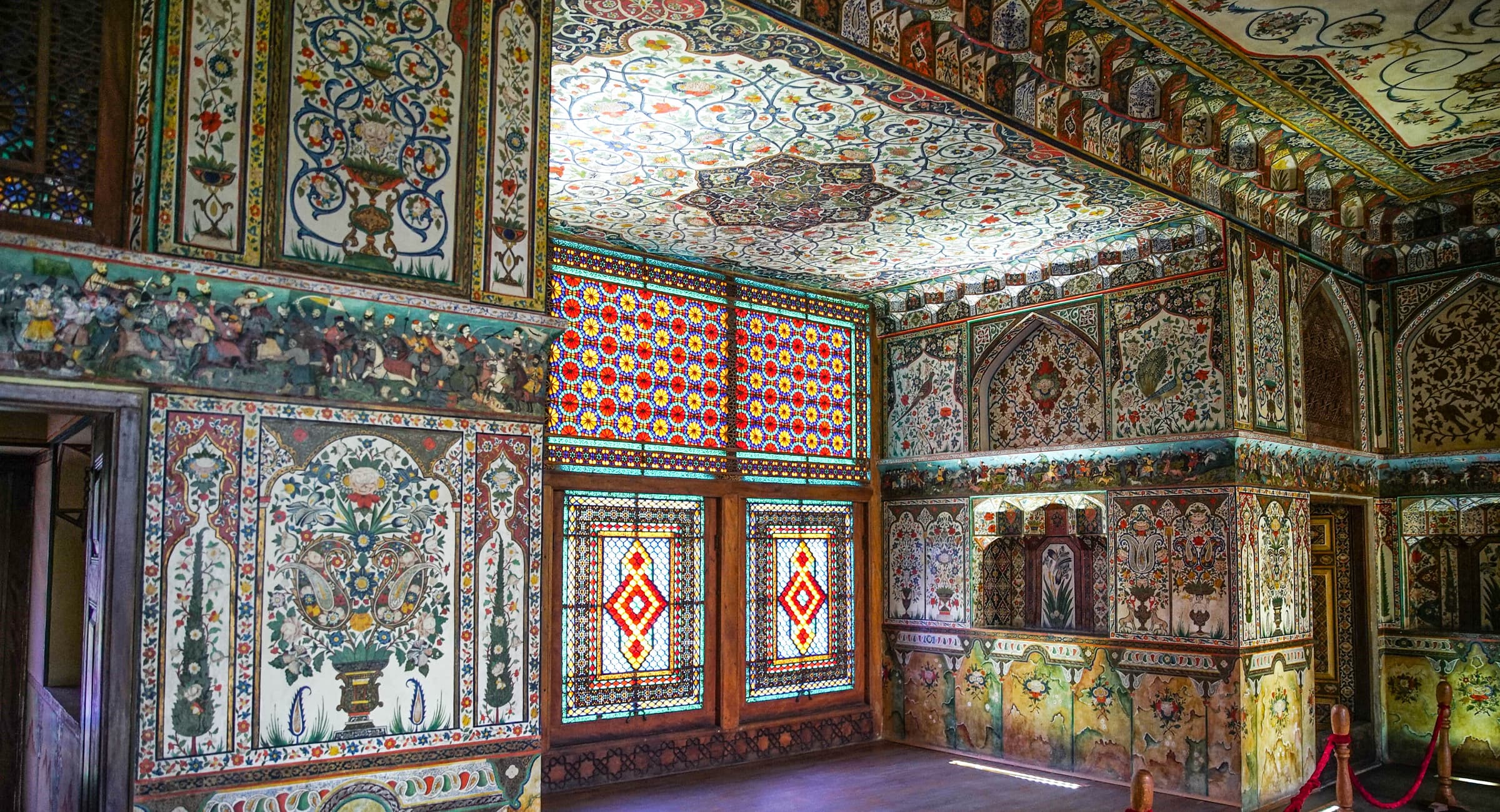
Visit the Sheki Khan's Palace, renowned for its colourful stained-glass windows and wall paintings. The historic centre of Sheki with the Khan's Palace is a UNESCO World Heritage Site associated with the Silk Road, silk production and trade. Merchant houses and caravanserais recall this prosperous past. Inside the eighteenth-century palace, floral motifs and hunting scenes decorate the walls. The shebeke stained-glass windows combine small pieces of coloured glass with wooden latticework assembled without nails or glue. Sunlight casts geometric patterns across the rooms, demonstrating the precision and skill of local craftsmen. Overnight stay in Sheki. (B/L/-)
After breakfast, visit the bazaar in Sheki. Continue to Goygol to explore the German quarter and the Lutheran church. The town of Goygol originated as Helenendorf, founded in 1819 by settlers from Württemberg. Its regular street layout, houses with gardens and Lutheran church preserve traces of the former German community. This heritage relates to the town and its German quarter and is distinct from Lake Goygol and the national park. Lunch during the journey. Continue to Ganja. Visit the Juma Mosque, the Imamzadeh Mausoleum and the city's caravanserais. Overnight stay in Ganja. (B/L/-)
After breakfast, return to Baku, stopping at the mausoleum of the poet Nizami. Nizami Ganjavi, a twelfth-century poet associated with Ganja, is renowned for the Khamsa, a cycle of five narrative poems. His stories combine love, moral reflection, legends and royal figures, inspiring miniature paintings throughout the region. The mausoleum commemorates his literary legacy and Ganja's role in the cultural history of the Caucasus. Arrive in Baku in the afternoon, with free time to explore the city or relax. Lunch is included. Overnight stay in Baku. (B/L/-)
Breakfast at the hotel. Depart for Guba, travelling through the magnificent landscapes of the Caucasus. Along the way, stop at the Candy Cane Mountains in the Khizi region, famous for their spectacular colourful stripes. Continue with a visit to the Red Settlement (Qırmızı Qəsəbə), a historic settlement of Mountain Jews, and a traditional carpet workshop, where visitors will discover the ancient art of Azerbaijani carpet weaving. Lunch at a restaurant.
In the afternoon, enjoy an excursion to Khinalig, one of Azerbaijan's most picturesque mountain villages, where ancestral traditions and breathtaking landscapes come together to create a unique atmosphere. Khinalig forms part of the UNESCO World Heritage property Cultural Landscape of Khinalig People and the Köç Yolu Transhumance Route, recognised for its mountain settlement, seasonal pastures and long-established way of life. Visit the local History Museum. Return to Baku. Dinner at leisure and overnight stay at the hotel. (B/L/-)
Breakfast at the hotel and free time until departure, according to your flight schedule. Optional transfer to the airport. Check-out is by 12:00 noon. (B/-/-)
Programme routeOpen the route map+
VATRAVEL · Full journey
Your journey, on the map
Select a day to explore the main stops of your programme.
Route overview: arrows show the order of visits, not driving or hiking directions. See the full programme for all stops.