
Travel programme
Azerbaijan - Georgia : Exploring the Rich Heritage
A Journey to the Historic Cities of the Caucasus
10 days•9 nights
Programme routeOpen the route map
VATRAVEL · Full journey
Your journey, on the map
Select a day to explore the main stops of your programme.
Route overview: arrows show the order of visits, not driving or hiking directions. See the full programme for all stops.
Travel programme
Upon arrival in Azerbaijan, be greeted by your local guide and transferred to your hotel, a 25 km journey through the bustling heart of the city. After checking in, take some time to relax and prepare for the captivating journey ahead. Overnight stay at the hotel.
Start the day with a delightful breakfast at the hotel, followed by a visit to the Alley of Martyrs, the highest point in Baku. From this stunning vantage point, gaze upon the magnificent Baku Bay, often compared to the bay of Naples. Continue your journey through the enchanting Old City, where elegant 20th-century buildings, once the homes of wealthy Azerbaijani oil magnates, stand as silent witnesses to the city’s rich history. Visit historical gems like the Shirvanshahs Palace, the Maiden Tower, and ancient mosques, each one telling a story of Azerbaijan’s vibrant past. Icherisheher is Baku’s inhabited walled city, recognised by UNESCO together with the Shirvanshahs’ Palace and Maiden Tower. Its narrow lanes connect mosques, caravanserais and bathhouses that served the medieval trading town. The fifteenth-century palace complex was the royal residence of the Shirvan rulers; the cylindrical Maiden Tower, with its thick stone walls, is one of the city’s oldest landmarks. Their architecture shows Baku’s history before the oil boom reshaped the surrounding streets.
Next, venture to Gobustan, a UNESCO World Heritage Site, where ancient rock paintings—more than 7,000 in total—give a glimpse into the life of prehistoric humans. Gobustan’s UNESCO-listed rock-art landscape preserves thousands of engravings on the boulders of a semi-desert plateau. Hunters, wild animals, boats and groups of dancers record how successive communities lived, travelled and expressed their beliefs. The museum explains these images in the context of prehistoric settlements and changes in the environment, making the small figures on the stone easier to understand.
Visit the contemporary museum, where modern technology brings to life scenes of hunting, feeding, and burial. Continue to admire the mud volcanoes, a natural marvel of Azerbaijan, where more than a hundred volcanoes continuously erupt with liquid mud, creating a lunar-like landscape. The mud volcanoes are driven by gases rising through water and sediment below the ground. Bubbles break the grey surface and small cones build up around the vents, forming a bare, sculpted landscape very different from a lava volcano. Azerbaijan has an exceptional concentration of these formations. They are a natural attraction separate from Gobustan’s UNESCO rock-art property.
Conclude the day with a visit to the majestic Bibi-Heybat Mosque, before heading back to Baku for a relaxing night at the hotel. Bibi-Heybat is a pilgrimage mosque on Baku’s southern approach, facing the Caspian coast. The present complex reconstructs a historic sanctuary destroyed during the Soviet period. Its domes, minarets and decorated interior make it a landmark of the city’s Islamic heritage; it remains an active religious place, so the visit follows the rules of worship and access in force.
Overnight stay at the hotel.
Begin your day with a hearty breakfast at the hotel, followed by a trip to the Absheron Peninsula. Here, visit the Atashgah Fire Temple in the village of Surakhani, a revered religious site of the Zoroastrians. Ateshgah’s stone enclosure surrounds a central fire altar and the small cells once used by pilgrims. Its inscriptions and courtyard recall the Hindu and Sikh merchants who travelled to Absheron, alongside the region’s older fire-worship traditions. The surviving complex largely dates to the seventeenth and eighteenth centuries, when Baku’s trade routes brought visitors from the Indian subcontinent.
Explore the Mardakan Fortress, a testament to the region’s ancient fortifications, and the Mirmovsum Aga Mausoleum in Shuvelan, famous for its ornate gold and silver mirror decorations. Your journey continues with a visit to Yanardag, the Burning Mountain, where natural gas erupts continuously from the ground, creating a captivating fire that has been burning for centuries. At Yanar Dag, natural gas escaping through the hillside feeds a line of flames at the base of the rock. The fire comes from the ground rather than a volcanic eruption, offering a visible explanation of Azerbaijan’s “Land of Fire” name. The low ridge and exposed rock make the phenomenon easy to distinguish from the fire altar at Ateshgah.
Return to Baku and marvel at the futuristic Cultural Center (exterior visit only) designed by Zaha Hadid. Later, visit the exquisite Azerbaijan National Carpet Museum, where the architecture itself is inspired by the art of carpet weaving, one of Azerbaijan’s most treasured traditions. The Carpet Museum’s rolled-carpet shape announces the collection inside. Regional weaving traditions can be distinguished through their colours, geometric borders and floral motifs; flat-woven pieces and knotted carpets show different techniques. The displays explain the role of carpets in homes and ceremonies, turning a familiar decorative object into a record of local craftsmanship.
As night falls, enjoy a Baku night excursion to the city’s stunning viewpoints. Overnight stay at the hotel.
After breakfast, embark on a scenic journey to Sheki, stopping along the way to visit the Diri Baba Mausoleum, a breathtaking structure built into the rocks in 1402. Built in 1402, Diri Baba is a two-storey mausoleum set directly against a rocky hillside. Its compact stone façade, arched openings and domed chamber belong to the Shirvan–Absheron architectural tradition. The unusual position makes the building appear to grow out of the cliff, while local legends explain its long history as a place of pilgrimage.
Continue to Shamakhi, once the capital of the Shirvanshahs State, where you will visit the oldest mosque in Azerbaijan and the awe-inspiring Yeddi Gumbaz Mausoleum. Then, head to the Orthodox Church in Nij Village, a beautiful relic of the region’s diverse religious history. Upon arrival in Sheki, immerse yourself in the beauty of this charming city. Overnight stay.
After breakfast, visit Kish Village to see the Paleo-Christian Church, dating back to between the 1st and 5th centuries, a testament to the ancient kingdom of Caucasian Albania. Kish’s stone church stands in a village at the foot of the wooded mountains near Sheki. Its domed silhouette and compact interior introduce the Christian heritage associated with ancient Caucasian Albania, a historical kingdom unrelated to present-day Albania. The museum setting explains the building’s successive periods and the archaeological finds around it.
Discover the majestic Khan Palace, famous for its rich decorations, as well as the Sheki House of Artisans and the magnificent Caravanserai. Sheki’s historic centre and Khan’s Palace form a UNESCO World Heritage property shaped by the Silk Road, silk production and trade. Merchant houses and caravanserais reflect the town’s commercial past. Inside the eighteenth-century palace, floral paintings and hunting scenes cover the walls; shebeke windows combine small pieces of coloured glass and fitted wood without nails or glue. Sunlight projects their geometric patterns into the rooms, revealing the skill of local craftsmen.
Afterward, travel to Goygol, where the German Quarter reveals a fascinating piece of history with its 19th-century German houses and Lutheran Church. The town of Goygol grew from Helenendorf, founded in 1819 by settlers from Württemberg. Straight streets, houses with gardens and the Lutheran church preserve traces of that community. This heritage concerns the town and its former German quarter; it is distinct from Lake Goygol and the national park, whose visit depends on the actual itinerary.
Continue on to Ganja, Azerbaijan’s second-largest city, and visit landmarks like the Shah Abbas Mosque, the Javad Khan Mausoleum, and the historic Alexander Nevski Church. Overnight stay at the hotel.
Start your day with breakfast at the hotel before exploring the cultural and historical sites in Ganja, including the Shah Abbas Mosque, the Javad Khan Mausoleum, the Chokek Hamam, and the Nizami Mausoleum. Nizami Ganjavi, the twelfth-century poet associated with Ganja, is renowned for the Khamsa, a cycle of five narrative poems. His stories combine love, ethics, legends and portraits of rulers, and have inspired manuscript illustration across the region. The mausoleum commemorates this literary heritage and Ganja’s place in the cultural history of the Caucasus.
Afterward, make your way to the border with Georgia, where you’ll complete customs formalities and transfer to a Georgian guide and vehicle. Arrive in Tbilisi, the Georgian capital, where you will be warmly welcomed. Hotel accommodation. Overnight stay.
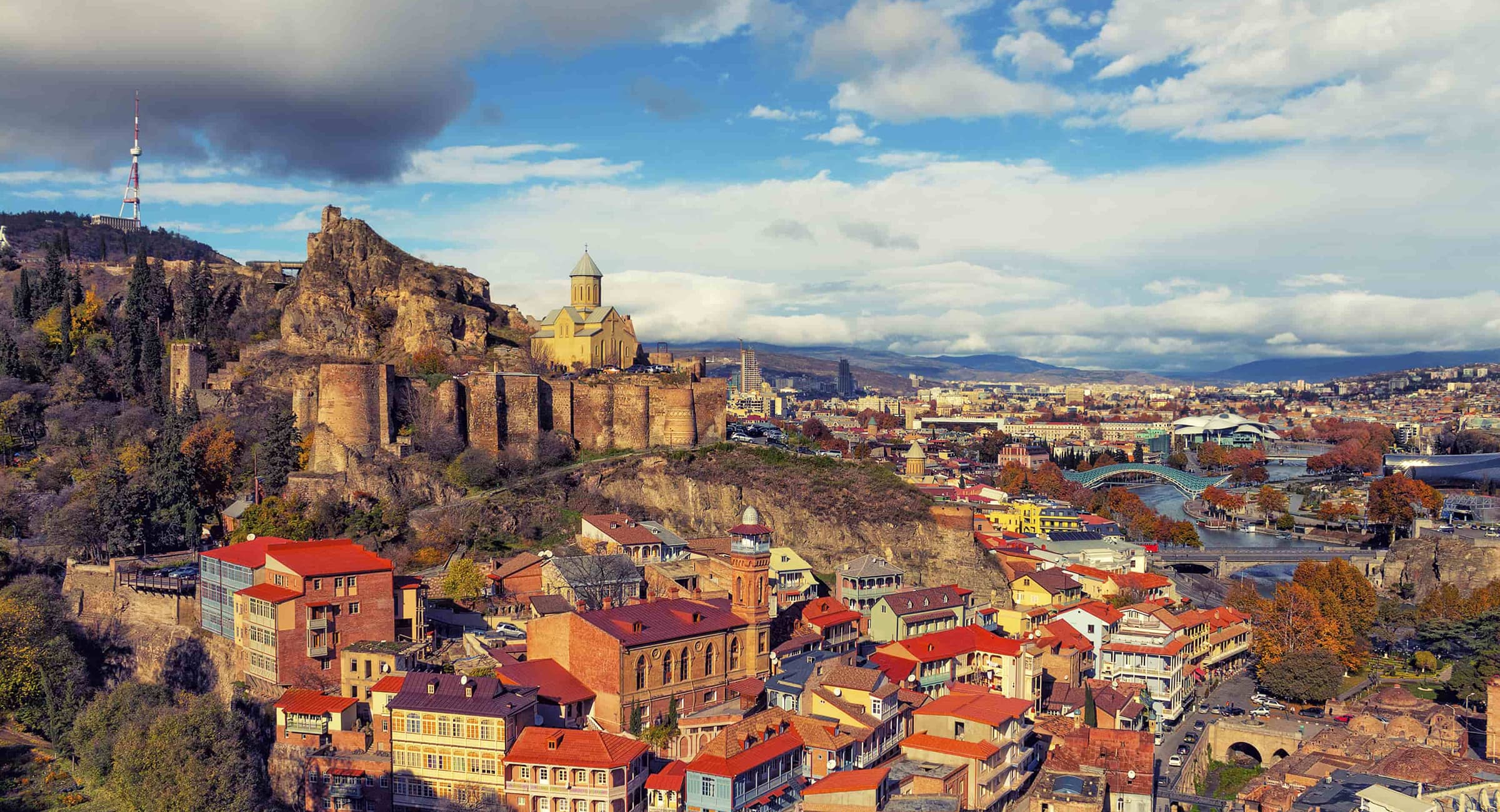
Breakfast at the hotel. Spend the day discovering Tbilisi, Georgia’s captivating capital, known for its rich history and stunning architecture. Begin with the Sulphur Baths and the Botanical Garden, and explore the ancient Narikala Fortress, dating back to the 4th century. Tbilisi’s old town developed along the Mtkvari river, beneath the ridge of Narikala. Wooden balconies project over winding streets, while churches, a synagogue and the bath district show the communities that shaped the city. Metekhi stands above the river on its rock, and the small Anchiskhati basilica contrasts with the larger Sioni Cathedral. These landmarks explain the capital through its neighbourhoods and religious buildings rather than a single architectural style.
Visit the Sioni Cathedral and the Anchiskhati Basilica, two of Tbilisi’s oldest churches, and immerse yourself in the rich history of the National Museum of Georgia, home to an incredible archaeological treasure. End your exploration with a stroll along Rustaveli Avenue, Tbilisi’s lively main street. Overnight stay.
Breakfast. Depart for Mtskheta, Georgia’s ancient capital and spiritual heart. Visit the Jvari Church (6-7th century) and the Svetitskhoveli Cathedral (11th century), two UNESCO World Heritage Sites with deep religious significance. Mtskheta was the capital of the ancient kingdom of Iberia and remains a centre of Georgian Christianity. Jvari’s sixth-century church overlooks the meeting of the Aragvi and Mtkvari rivers; its cross-shaped plan helped define Georgian church architecture. In town, the eleventh-century Svetitskhoveli Cathedral is associated with the tradition of Christ’s robe and the burials of Georgian rulers. Both monuments belong to Mtskheta’s UNESCO World Heritage property.
Continue your journey along the breathtaking Great Caucasus Mountains via the Great Georgian Military Highway, stopping at the Ananuri Complex (17th century) for incredible views of the landscape. Ananuri is a fortified complex overlooking the Zhinvali reservoir on the Georgian Military Road. Defensive towers and curtain walls surround churches whose carved façades include crosses, vines and animal figures. The ensemble was a stronghold of the Aragvi rulers and shows how a religious centre and a defensive residence could share the same protected site.
Arrive in Gudauri, a resort town nestled in the mountains. Hotel accommodation. Overnight stay.
Breakfast at the hotel. Embark on a scenic journey along the Tergi River to Kazbegi, a municipality known for its natural beauty. Take a peaceful, hour-and-a-half walk from Kazbegi to the Gergeti Trinity Church, located at an altitude of 2170 meters. Gergeti Trinity Church is a fourteenth-century stone church above Stepantsminda, framed by the high Caucasus. Its separate bell tower and domed church stand on an exposed ridge, making the setting as distinctive as the carved stonework. On clear days the surrounding slopes open towards Mount Kazbek; the mountain view and access remain dependent on the weather.
On clear days, you can catch a glimpse of Mount Kazbegi (5047 meters), one of the highest glaciers in the Caucasus. After exploring, return to Tbilisi for some leisure time. Hotel accommodation. Overnight stay.
After breakfast, transfer to Tbilisi airport, where your unforgettable journey through the Caucasus region concludes. Take with you lasting memories of Azerbaijan and Georgia, two countries rich in history, culture, and natural beauty.
