
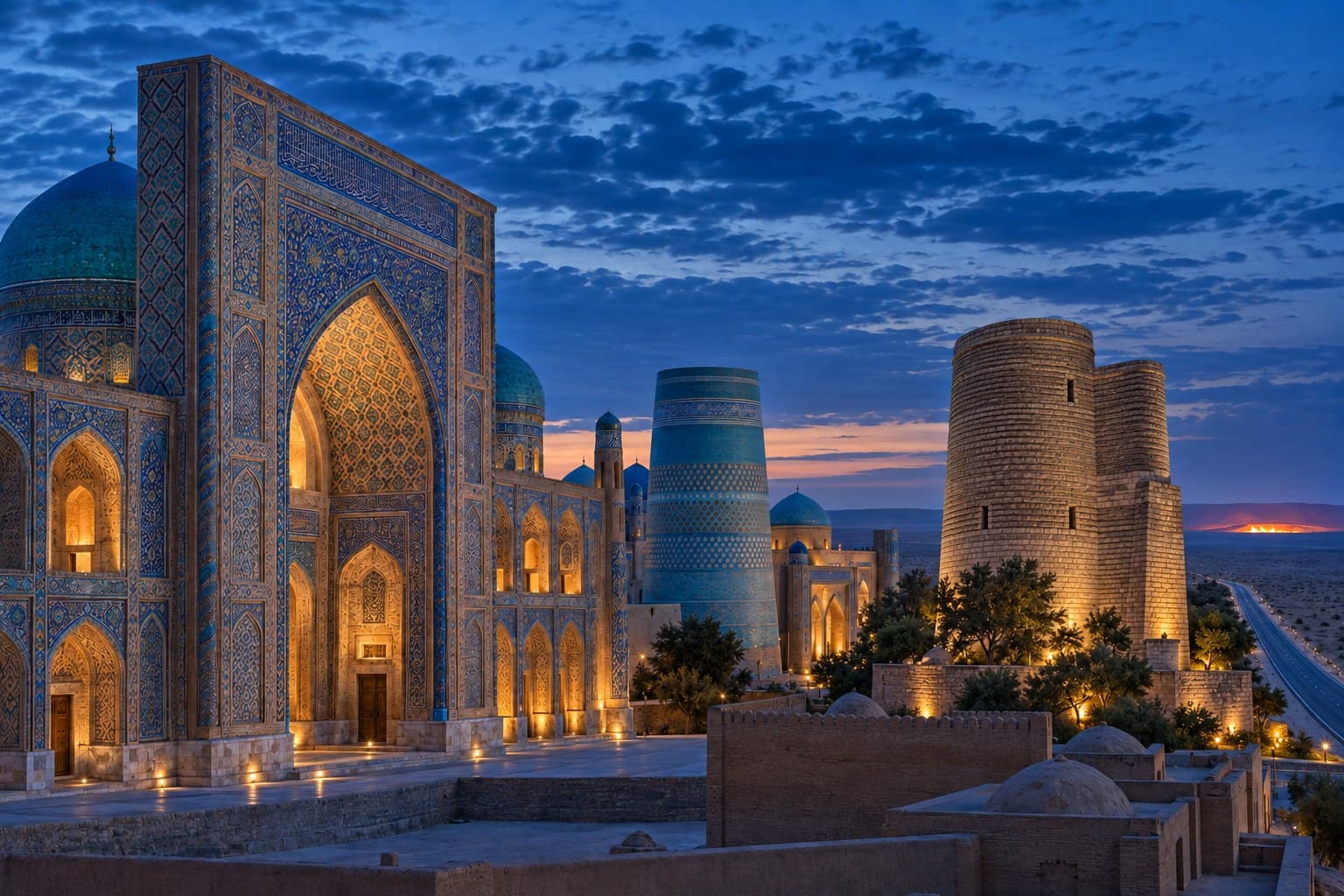
Baku · Guba · Khinalig · Tashkent · Samarkand · Bukhara · Khiva · Darvaza · Ashgabat
Azerbaijan, Uzbekistan and Turkmenistan – The Marco Polo Route
A fifteen-day journey across the Caspian and Central Asia: from Baku and the villages of the Caucasus to Samarkand, Bukhara and Khiva, the Darvaza crater and Ashgabat. Programme with an English-speaking guide. Flight and train schedules will be reconfirmed before travel. Ask our team for a private proposal for your agency.
15 days · 14 nights
Upcoming departures
New dates on request
No upcoming dates are published for this programme yet. Contact our team to discuss your plans.
Explore the itinerary
Travel Program
Arrival at Baku airport. Optional transfer to the hotel and overnight in the city.
The tour starts at 09:15.
Breakfast and an excursion to Gobustan to visit the museum and discover the region's petroglyphs. Gobustan’s UNESCO-listed rock-art landscape preserves thousands of engravings on the boulders of a semi-desert plateau. Hunters, wild animals, boats and groups of dancers record how successive communities lived, travelled and expressed their beliefs. The museum explains these images in the context of prehistoric settlements and changes in the environment, making the small figures on the stone easier to understand.
Continue to the mud volcanoes and return to Baku to visit the Bibi-Heybat Mosque. The mud volcanoes are driven by gases rising through water and sediment below the ground. Bubbles break the grey surface and small cones build up around the vents, forming a bare, sculpted landscape very different from a lava volcano. Azerbaijan has an exceptional concentration of these formations. They are a natural attraction separate from Gobustan’s UNESCO rock-art property. Bibi-Heybat is a pilgrimage mosque on Baku’s southern approach, facing the Caspian coast. The present complex reconstructs a historic sanctuary destroyed during the Soviet period. Its domes, minarets and decorated interior make it a landmark of the city’s Islamic heritage; it remains an active religious place, so the visit follows the rules of worship and access in force.
Walk through Icherisheher, including the Palace of the Shirvanshahs, the Maiden Tower, the ruins of St Bartholomew's Church, old hammams and historic mosques. Icherisheher is Baku’s inhabited walled city, recognised by UNESCO together with the Shirvanshahs’ Palace and Maiden Tower. Its narrow lanes connect mosques, caravanserais and bathhouses that served the medieval trading town. The fifteenth-century palace complex was the royal residence of the Shirvan rulers; the cylindrical Maiden Tower, with its thick stone walls, is one of the city’s oldest landmarks. Their architecture shows Baku’s history before the oil boom reshaped the surrounding streets.
Lunch included. Dinner at leisure and overnight in Baku.
Breakfast and a visit to the Baku viewpoint overlooking the Caspian bay. Excursion to the Absheron Peninsula to visit the Ateshgah Fire Temple in Surakhani and Yanar Dag, the Burning Mountain. Ateshgah’s stone enclosure surrounds a central fire altar and the small cells once used by pilgrims. Its inscriptions and courtyard recall the Hindu and Sikh merchants who travelled to Absheron, alongside the region’s older fire-worship traditions. The surviving complex largely dates to the seventeenth and eighteenth centuries, when Baku’s trade routes brought visitors from the Indian subcontinent. At Yanar Dag, natural gas escaping through the hillside feeds a line of flames at the base of the rock. The fire comes from the ground rather than a volcanic eruption, offering a visible explanation of Azerbaijan’s “Land of Fire” name. The low ridge and exposed rock make the phenomenon easy to distinguish from the fire altar at Ateshgah.
On returning to Baku, visit the Heydar Aliyev Center (exterior visit only), designed by Zaha Hadid, and Yashil Bazaar, known for fresh produce, spices and local specialities. Zaha Hadid’s Heydar Aliyev Center is recognised by its continuous white curves: the building’s surface rises from the plaza and folds into the roof, avoiding the straight lines of a conventional façade. From outside, the changing angles reveal how the architecture and landscaped space form one composition. This stop concerns the exterior, without promising entry to the exhibitions. Yashil Bazaar’s stalls display seasonal fruit, herbs, nuts, dried fruit and fragrant spices. Pomegranates, tea and preserves are among the products associated with Azerbaijani kitchens. The market shows how produce from different regions reaches Baku and offers a close look at everyday shopping, from stacked baskets of fruit to the small stalls of pickles and local specialities.
Lunch included and overnight in Baku.
After breakfast, visit the YARAT contemporary art space and the Carpet Museum. The Carpet Museum’s rolled-carpet shape announces the collection inside. Regional weaving traditions can be distinguished through their colours, geometric borders and floral motifs; flat-woven pieces and knotted carpets show different techniques. The displays explain the role of carpets in homes and ceremonies, turning a familiar decorative object into a record of local craftsmanship. YARAT presents contemporary art in a converted industrial building by the waterfront. Exhibitions use painting, installation, photography and moving images to explore modern life and ideas from Azerbaijan and the wider region. It offers a different perspective from the historical collections elsewhere in Baku, with the particular works varying as exhibitions change.
Walk along the Caspian seafront boulevard and have lunch at a local restaurant. In the afternoon, visit the National Museum of History of Azerbaijan and the house of Haji Zeynalabdin Taghiyev. The National History Museum occupies the former mansion of oil entrepreneur and philanthropist Haji Zeynalabdin Taghiyev. Archaeological objects, weapons, coins and household items trace different periods of Azerbaijan’s history. The restored family rooms also show how Baku’s oil wealth was expressed in decorated ceilings, reception halls and the furnishings of a late nineteenth-century residence.
Return to the hotel and overnight in Baku.
Morning departure for Guba and a visit to the Red Village, Qırmızı Qəsəbə. Continue to a traditional carpet workshop and have lunch in a local home. In the afternoon, travel to Khinalig and visit its Local History Museum. Khinalig’s stone houses are built close together on a steep mountain slope, with roofs and terraces adapting to the uneven ground. The community has its own language and a pastoral economy linked to seasonal movement. UNESCO recognises the cultural landscape of its people and the Köç Yolu transhumance route: the network connecting the village with summer and winter grazing lands. The heritage therefore includes both the settlement and the continuing practice of mountain herding.
Return to Baku and transfer to the airport for the direct flight to Tashkent. Arrive in the early hours, meet the local guide and driver, transfer to the hotel and stay overnight. The flight schedule will be reconfirmed before travel.
Breakfast and a tour of old Tashkent: the Hazrati Imam complex, Barak-Khan Madrasa, Tillya Sheikh Mosque and Abu Bakr Kaffal Shashi Mausoleum. Tashkent’s Hazrati Imam complex brings together madrasahs, mosques and the mausoleum of Kaffal Shashi. Chorsu’s large covered bazaar contrasts with the carved woodwork and decorative objects at the Museum of Applied Arts. Below the city, the metro stations use mosaics, marble and themed ornament: Kosmonavtlar recalls space exploration, while Alisher Navoi draws on the region’s literary and architectural heritage.
Visit Chorsu Bazaar, the Museum of Applied Arts and the Kosmonavtlar and Alisher Navoi metro stations. Lunch, followed by Amir Timur Square and Theatre Square. In the afternoon, transfer to the station for the train to Samarkand. Arrive and transfer to the hotel.
Breakfast and a visit to Registan Square, with the Ulugbek, Sher-Dor and Tilla-Kori madrasas. Samarkand’s UNESCO-listed monuments reveal its role as a centre of Timurid power and scholarship. Registan’s three madrasahs frame a square with tiled portals and patterned façades; Gur-e-Amir is the dynastic mausoleum associated with Timur. Bibi-Khanym’s monumental scale and Shakhi-Zinda’s closely spaced tombs show different uses of glazed tile, calligraphy and geometric ornament. The nearby Siab market continues the city’s trading tradition in everyday food stalls.
Continue to the Gur-e Amir Mausoleum, Bibi-Khanym Mosque and Siab Bazaar. Lunch at a local restaurant and an afternoon visit to the Shakhi Zinda necropolis. Overnight in Samarkand.
Breakfast and transfer to the station for the journey to Bukhara. If train seats are unavailable, the journey will be made by road. On arrival, visit the Samanid Mausoleum, Chashma Ayub, Bolo Hauz Mosque and the Ark Citadel. Bukhara’s UNESCO-listed historic centre retains the layout of a trading and religious city. The Samanid Mausoleum creates intricate patterns with brickwork instead of coloured tiles. The Ark was the fortified seat of the rulers, while the Kalyan minaret and surrounding mosque and madrasah mark the religious centre. Covered trading domes and the pool at Lyabi-Hauz show how markets, learning and social life shared the same streets.
After lunch, tour the Kalyan Minaret, Poi Kalyan Mosque, Miri Arab Madrasa, the covered markets of Toki Zargaron, Toki Telpak Furushon and Toki Sarafon, the Ulugbek and Abdullazizkhan madrasas, Magoki Attori Mosque, the Lyabi Hauz complex and Chor Minor. Overnight in Bukhara.
After breakfast, travel by road to Khiva through the Kyzylkum Desert. The journey is approximately 451 km and seven hours. Lunch en route. Arrive at the hotel and enjoy free time to rest. Overnight in Khiva.
Breakfast and a tour of Ichan-Kala. Itchan Kala is Khiva’s UNESCO-listed inner city, enclosed by thick earthen walls. Kalta Minor is recognisable by its broad, unfinished form and turquoise tilework, while the taller Islam Khodja minaret rises above the rooftops. Palaces, madrasahs and mausoleums occupy the compact lanes; carved wooden columns and decorated courtyards reveal the craftsmanship of the khanate’s capital.
Visit Kalta Minor, Kunya Ark Fortress, the Mohammed Rahim Khan and Islam Khodja madrasas, Tash Hovli Palace, the Pahlavan Mahmud Mausoleum and Allakulikhan Madrasa. Lunch at a local restaurant. Overnight at the hotel within the historic walled city.
Breakfast and transfer to the Shavat border to enter Turkmenistan. Continue towards Darvaza through the Dashoguz region, a journey of approximately 300 km. Visit the gas crater and view the landscape at dusk. Barbecue dinner and overnight near the crater.
Picnic breakfast and a road transfer of approximately 280 km to Ashgabat. In the afternoon, tour the city and its buildings and monuments: the Presidential Palace, Ruhyyet Palace, Wedding Palace, Yildyz Hotel, observation wheel, Constitution Monument, Arch of Neutrality, Independence Monument and Park, Ertogrul Gazi Mosque, sports facilities and residential complexes. Lunch included and overnight in Ashgabat.
After breakfast, visit Nisa Fortress near Bagyr and the National Museum of History and Ethnography. The UNESCO-listed Parthian Fortresses of Nisa preserve the remains of Old and New Nisa near the Kopet Dag foothills. Old Nisa served as an important royal centre of the Parthian world. Excavated walls, ceremonial spaces and storage buildings reveal a culture that combined local traditions with Hellenistic influences, long before the modern marble avenues of nearby Ashgabat.
Continue to Kipchak to see the Turkmenbashy Ruhy Mosque. Visit the Halk Hakydasy memorial complex and the Watan Mukaddesligi Museum. Lunch included and overnight in Ashgabat.
Breakfast and departure for Gokdepe via Arkadag, at the foot of the Kopetdag Mountains. Visit an Akhal-Teke horse farm, Gokdepe Fortress and Saparmyrat Hajy Mosque. The Akhal-Teke horse takes its name from the Ahal oasis and the Teke people. A slender build, long neck and fine coat distinguish the breed, developed through generations of Turkmen horse husbandry. The breeding knowledge and traditions of horse decoration are recognised by UNESCO as intangible heritage. A farm visit introduces the care and training behind this emblem of Turkmen culture.
Meet a local family to learn about traditional clothing, carpet and felt making, and the preparation of dishes such as dograma and ishlekli, traditional bread and pishme. Share lunch with the family. Return to Ashgabat and visit Gulistan Bazaar. Overnight at the hotel.
Transfer to Ashgabat International Airport and departure on the return flight.
Programme routeOpen the route map
VATRAVEL · Full journey
Your journey, on the map
Select a day to explore the main stops of your programme.
Route overview: arrows show the order of visits, not driving or hiking directions. See the full programme for all stops.
