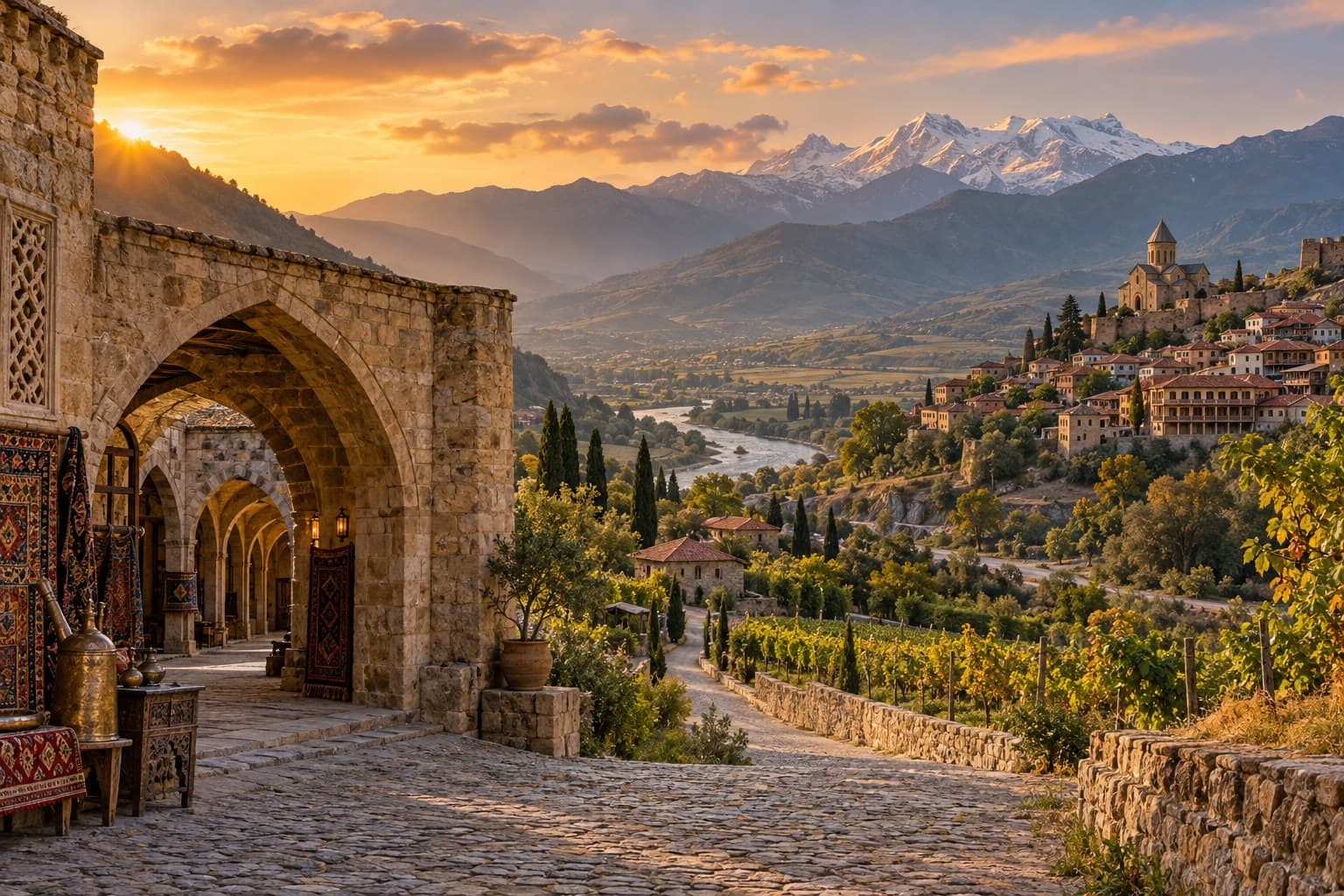
Azerbaijan and Georgia – The bridge between East and West
A nine-day journey from Baku to Tbilisi through the fire landscapes of Absheron, Gobustan’s rock art, Sheki, Kakheti and the Greater Caucasus. English-speaking guides introduce the history, architecture and local traditions along the route. Contact our team for a private proposal.
Arrival at Baku International Airport. Optional transfer to the hotel and overnight in Baku. (-/-/-)
The tour starts at 09:15.
After breakfast, departure for the Absheron Peninsula, a fascinating place that combines spiritual and natural beauty. The visit begins with the Fire Temple of Atashgah, located in the village of Surakhani, a historic fire sanctuary associated with Hindu and Sikh pilgrims and the region’s older fire-worship traditions. Next, admire the spectacular Yanardag, the “Burning Hill,” one of the natural wonders of Azerbaijan, where natural gas emerges from the rocks creating continuous flames. Lunch at a local restaurant.
On the return to Baku, view the exterior of the Heydar Aliyev Cultural Center designed by Zaha Hadid, whose futuristic architecture stands out in the city skyline. Not far away, visit Yashil Bazar (literally “Green Market”), one of the liveliest and most authentic markets in Baku, Azerbaijan. Located in the heart of the city, it offers a colorful glimpse of local life. It is known for its abundance of fresh produce, dried fruits, spices, nuts, and traditional Azerbaijani delicacies. Return to Baku. Arrival at the hotel. Overnight in the hotel. (B/L/-)
After breakfast, depart for Gobustan to explore its museum and rock-art landscape, inscribed on the UNESCO World Heritage List. More than 6,000 engravings record animals, hunting, boats and ritual dances, with the wider landscape bearing testimony to 40,000 years of rock art. The museum helps explain the archaeological discoveries before the walk among the original petroglyphs.
Continue to the mud volcanoes, where gas and cold mud emerge through small cones, creating a bare, sculpted landscape. These geological formations are a separate natural attraction from the UNESCO-listed rock-art property. Visit the Bibi-Heybat Mosque before returning to Baku for lunch at a local restaurant.
In the capital, enjoy the panoramic viewpoint above Baku Bay, formerly known as Upland Park. Continue to Icherisheher, the inhabited historic heart of Baku. The Walled City of Baku, with the Palace of the Shirvanshahs and the Maiden Tower, is a UNESCO World Heritage property. Walk through its narrow streets and see the historic mosques, the palace, the Maiden Tower, the ruins of St Bartholomew’s Church and the old hammam. Overnight in Baku. (B/L/-)
After breakfast, departure for Sheki, one of the most important cities along the Silk Road. Along the way, stop at the village of Mereze (Gobustan) to visit the Diri Baba Mausoleum, built in 1402 and associated with local traditions about a Sufi holy man. The sanctuary was built using a natural cave in the rock face and over the centuries has become a pilgrimage site. In Shamakha, visit the historic Juma Mosque, one of the oldest mosques in the region, beautifully restored and showcasing the architectural and spiritual heritage of the area. Lunch at a local restaurant.
Arrival in Sheki, one of the key cities along the Silk Road. Transfer to the village of Kish to visit a church and museum associated with the early Christian heritage of Caucasian Albania. Overnight at the hotel. (B/L/-)
After breakfast, enjoy a guided tour of the evocative Khan’s Palace, appreciating its intricate decorations. Sheki’s historic centre with the Khan’s Palace is a UNESCO World Heritage property shaped by Silk Road trade. Its colourful shebeke windows and wall paintings reflect the skill of the town’s craftsmen. Next, visit the craftsmen's house of Sheki and the Caravanserai in the city of Sheki.
Afterwards, depart for the Georgia-Azerbaijan border at Lagodekhi. Continue via Gremi to Tbilisi. Check-in at the hotel. Overnight in Tbilisi. (B/L/-)
Breakfast at the hotel. Today, we visit Tbilisi, the capital of Georgia, which was founded in the 5th century. We begin our day with a visit to the medieval Church of Metekhi (13th century), followed by a cable car ride to the Narikala Fortress area, which majestically overlooks the old quarter of the city. We continue exploring the old city: the district of sulfur baths (17th century); the capital's name is inspired by these hot sulfur springs, as 'Tbili' means 'hot' in Georgian. Next, we visit the Sioni Cathedral (16th century) and Anchiskhati (6th century), the oldest church in the city. We will then take a walk along Rustaveli Avenue, the main avenue of Tbilisi.
Later, we head to the ancient capital of Georgia, Mtskheta, located at the intersection of the Military Road and the Silk Road. Here, we visit two monuments within the UNESCO World Heritage property Historical Monuments of Mtskheta: the Jvari Monastery (6th century), offering a splendid view of the confluence of the Mtkvari and Aragvi rivers, and the Svetitskhoveli Cathedral (11th century), one of the most sacred places in Georgia, as it is believed to house the tunic that once belonged to Christ. Return to the capital. Overnight at the hotel in Tbilisi. (B/L/-)
Breakfast at the hotel. This morning, we follow the Georgian Military Road to the north, passing through Gudauri (2,200 meters), a winter sports resort on the southern slope of the Greater Caucasus Mountain range. We cross the Cross Pass (2,395 meters above sea level) and arrive at the village of Stepantsminda, located at the foot of the impressive Mount Kazbek (5,047 meters above sea level), which marks the border with Russia. We reach the 14th-century Trinity Monastery of Gergeti by 4x4. Perched at an altitude of 2,170 meters on a promontory, it offers the most spectacular views of the Greater Caucasus. Lunch in Stepantsminda.
On the way back to Tbilisi, we visit the fortified complex of Ananuri (17th century), one of the country’s major sites, located next to the blue Jinvali Lake. Return to Tbilisi and overnight at the hotel. (B/L/-)
Breakfast at the hotel. A day dedicated to discovering the Kakheti wine region, located in the east of the country, and renowned for its hospitality. We head southeast to the desert landscape of David Gareja. Visit the monastic complex founded in the 6th century by the Assyrian monk David, who settled in a cave in the desert. Dozens of rock monasteries are decorated with beautifully colored frescoes and are considered masterpieces of medieval Georgian art.
Then, we stop at a traditional Georgian wine cellar in the village of Kakabeti for an organic wine tasting. The tasting will be followed by a typical lunch. Return to Tbilisi and overnight at the hotel. (B/L/-)
Breakfast at the hotel. Check-out. (Optional: Transfer to the Airport). (B/-/-)
Programme routeOpen the route map+
VATRAVEL · Full journey
Your journey, on the map
Select a day to explore the main stops of your programme.
Route overview: arrows show the order of visits, not driving or hiking directions. See the full programme for all stops.